World History Overview
Unless you are a world history buff, you probably do not have ready recall of world events that occurred in the time periods that the Bible covers. This brief history overview is intended to give readers a framework of reference for better perspective and appreciation of timeframes of events that the Bible speaks to.
These World History events are arranged chronologically,
earliest to latest
These history synopses are primarily from secular sources to avoid what some might view as parochial bias.
Dates ranging from 704 BC to
163 BC
This span of time includes the reigns of
emperors Sennacherib (king of Assyria from 705 BC to 681 BC), Nebuchadnezzar II (king of Babylonia from 605 BC to 562 BC), Cyrus, who founded and ruled the Achaemenian Empire from 559 BC until 530
BC, Darius (king of Persian Empire from 521 BC to 486 BC), Alexander
the Great (336 - 323 BC),
and other historic figures from about that period.
Because the earliest events preceded written languages – or at least the written records that have been found and deciphered - some of their dates are at best estimates or conjecture. The early events of the book of Genesis – from creation, itself, through the Tower of Babel – fall into the “Before 4-digits BC” timeframe. The earliest are estimated to be “Before 4000 BC; and the Tower of Babel to be “Before 2100 BC. Secular historians seem to offer no dates for those early events. For those who wish to delve deeper into Bible timelines, the BibleHub.com website offers Bible timelines that readers can access by clicking on the “TIM” (third option from the left) on that website,. The intent of this History Supplement Section is to provide a brief secular history overview that can be compared, reconciled, contrasted, and/or confirmed with the events recorded in the Bible. Secular history of these earliest Biblical events is sparse. Scholars have posited two dates for the life of Abraham: 2166 BC – 1991 BC; and alternatively, 2000 BC – 1700 BC.
704 - 681 BC
Sennacherib
(Sennacherib was probably born c. 745 BC in Nimrud and
ruled from 704 to 681BC)
Sennacherib
(Neo-Assyrian Sîn-ahhī-erība or Sîn-aḥḥē-erība, meaning "Sîn has replaced the brothers") was the king of the
Neo-Assyrian Empire from the death of his father Sargon II in 705 BC to his own death in 681 BC.
The second king of the Sargonid dynasty, Sennacherib is one of the most noted
Assyrian kings because of the role he plays in the Hebrew Bible, which
describes his campaign in the Levant*. Other events of his reign include his
destruction of the city of Babylon in 689 BC and his
renovation and expansion of the last great Assyrian capital, Nineveh.
*The Levant is a
region in the Eastern Mediterranean that encompasses the modern-day
countries of Turkey, Syria, Lebanon, Israel, Palestine, and
Jordan. The term “Levant” is not explicitly mentioned in the Bible, but it is
often used to refer to the ancient lands in the Old Testament. The kingdoms
of Israel, Ammon, Moab, Judah, Edom, and Aram, as well as the Phoenician and
Philistine states, are among the regions are associated with the Levant in the
Bible.
Although Sennacherib was one of the most
powerful and wide-ranging Assyrian kings, he faced considerable difficulty in
controlling Babylonia, which formed the southern portion of his empire. Many of
Sennacherib's Babylonian troubles came from the Chaldean tribal chief Marduk-apla-iddina II, who had been
Babylon's king until Sennacherib's father defeated and deposed him. Shortly
after Sennacherib inherited the throne in 705 BC,
Marduk-apla-iddina retook
Babylon and allied with the Elamites. Sennacherib reclaimed the south in 700 BC, but Marduk-apla-iddina continued to plague him, and likely instigated the
rebellion of the Assyrian vassals in the Levant, leading to the Levantine War
of 701 BC, involving a war against Bel-ibni,
Sennacherib's vassal king in Babylonia.
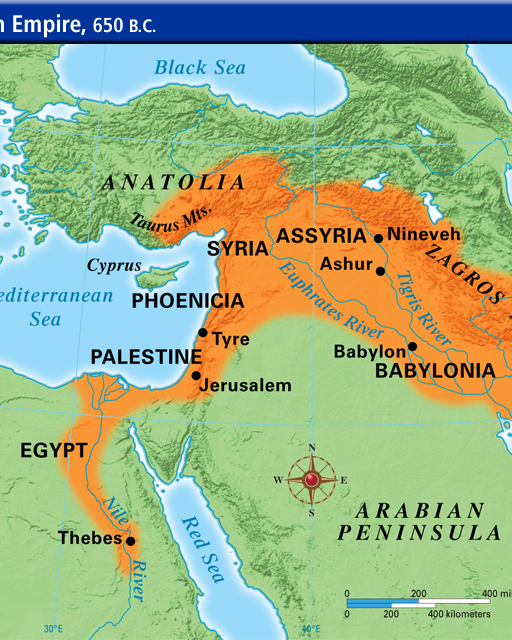
Map
of the Levant Region
After the Babylonians and Elamites
captured and killed Sennacherib's eldest son Aššur-nādin-šumi, whom Sennacherib had appointed as his new vassal king
in Babylon, Sennacherib invaded both regions, and subdued Elam. Since Babylon,
which was well within his realm, had often required his military intervention,
and had caused the death of his son, he destroyed the city in 689 BC.
In
the Levantine War, the states in the southern Levant, especially the Kingdom of
Judah under King Hezekiah, were not subdued as easily as those in the north.
The Assyrians therefore invaded Judah. Though the biblical narrative says that
divine intervention by an angel ended the Assyrian siege of Jerusalem by
destroying the Assyrian army, an outright defeat is unlikely, since Hezekiah
submitted to Sennacherib at the end of the campaign. Records from the period,
even those written by Assyria's enemies, do not mention the Assyrians being
defeated at Jerusalem.
Sennacherib
moved the capital of Assyria to Nineveh, where he had spent most of his time as
crown prince. To transform Nineveh into a capital worthy of his empire, he
launched an ambitious building project there, expanding the size of the city
and constructing great city walls, numerous temples, and a royal garden. His
most famous work in the city was the Southwest Palace, which Sennacherib named
his "Palace without Rival".
After
his eldest son’s death, Sennacherib first designated his second son, Arda-Mulissu as his heir. But later, in 684 BC,
he replaced him with a younger son, Esarhaddon, for unknown reasons.
Sennacherib ignored Arda-Mulissu's repeated appeals to be reinstated as heir,
and in 681 BC, Arda-Mulissu
and his brother Nabu-shar-usur murdered Sennacherib,
hoping to seize power for themselves. Babylonia and the Levant welcomed
Sennacherib’s death as divine punishment, while the Assyrian heartland probably
reacted with resentment and horror. Arda-Mulissu's
coronation was postponed, and Esarhaddon raised an army and seized Nineveh,
installing himself as king, as intended by Sennacherib.
By
the time Sennacherib became its king, the Assyrian Empire had been the dominant
power in the Near East for over thirty years, chiefly due to having a larger
and better-trained army than any other contemporary kingdom. Though Babylonia,
to the south, had once been a large kingdom, it was generally weaker, due to
internal ethnic divisions and a less disciplined army than its northern
counterpart during this period. Though old native Babylonians ruled most of the
cities, such as Kish, Ur, Uruk, Borsippa, Nippur, and
Babylon itself, Chaldean tribe leaders often squabbled with each in the
southernmost parts of the land; and the Arameans lived on the fringes of
settled land and were known for plundering surrounding territories. Because of
the infighting between these three major factions, Babylonia was often a target
for Assyrian campaigns. The two kingdoms had contended since the rise of the
Middle Assyrian Empire in the 14th century BC; and in the 8th
century BC, the Assyrians consistently held the upper hand. Babylon's
weaknesses, both internal and external, led to its being conquered by the
Assyrian king Tiglath-Pileser III in 729 BC.
As
Assyria grew into a major empire, they acquired many neighboring kingdoms,
either by conquering or annexing them as Assyrian provinces, or by turning them
into vassal states. Because the Assyrians respected the long history and
culture of Babylon, it was retained as a full kingdom, ruled either by an
appointed king, or by the Assyrian king in a personal union. The relationship
between Assyria and Babylonia was akin to the relationship between Greece and
Rome later in history; much of Assyria's culture, texts and traditions were
taken from the south. Assyria and Babylonia also shared the same language –
Akkadian, which contributed to the continued relationship between Assyria and
Babylon.
559 - 529 BC
Cyrus was born between 590 and 580 BC, either
in Media, or in Persis,
the modern Fārs province of Iran. He died around 529 BC in Asia.
The meaning of his name is in dispute, for it
is not known whether it was a personal name or a throne name given to him when
he became a ruler. Since the name Cyrus
does not appear in sources relating to Iran after his Achaemenian empire, it
may indicate the name may have some special meaning.
Most scholars agree that there was at
least one other “Cyrus” that ruled in Persia before Cyrus the Great. One
cuneiform text in Akkadian—the language of Mesopotamia (present-day Iraq) in
the pre-Christian era—asserts the following about Cyrus:
Son of Cambyses, great king, king of
Anshan, grandson of Cyrus, great king, king of Anshan, descendant of Teispes, great king, king of Anshan, of a family [which]
always [exercised] kingship.
Cyrus seems to have come from a long line of
ruling chiefs.
The Greek historian Herodotus is the best source of information about his
life. The biography by Xenophon was more intended as an example of an ideal
ruler for the Greeks
than a historical record.
But it also reveals the high esteem they held for Cyrus, not just among
Persians, but among the Greeks and others. Herodotus says the Persians called
Cyrus their father, while Achaemenian rulers who came after him were not as
highly regarded.
The story of Cyrus’ childhood, as related by
Herodotus might be better regarded as a Cyrus legend, that follows a pattern of folk
tales of almost superhuman attributes of the dynasty founder. Similar claims are also
made about the founders of other dynasties
of Iran later in history.
The legend claims
Astyages, king of the Medes
and overlord of the Persians, gave his daughter in marriage to a prince called Cambyses, the marriage that produced Cyrus. When Astyages had a dream that the baby would grow up to overthrow
him, he ordered Cyrus killed. However, his chief adviser gave the baby to a
shepherd to raise, instead. When Cyrus was 10 years old, Astyages learned he
was still living, and, in spite of the dream, was persuaded to let the boy live
because of his outstanding qualities. When he reached manhood in Persis, Cyrus
revolted against him. Astyages marched to quell the rebellion, but his army
deserted him and surrendered
to Cyrus in 550 BC.
As stated above, Cyrus was born to Cambyses I, King of Anshan, and Mandane, daughter of Astyages, King of Media, between 600 and 599 BC.
By his own account, believed to be accurate, Cyrus was preceded as king by his
father Cambyses I, grandfather Cyrus I, and great-grandfather Teispes.
Cyrus’s
Conquests
After he inherited the empire of the Medes,
Cyrus began consolidating his power over the tribes on the Iranian plateau
before extending his territory to the west. When Croesus, king of Lydia in Asia Minor, heard of the fall of Astyages,
he had expanded his domain by seizing territory from the Medes; and so, Cyrus,
as successor of the Median king, marched against Sardis, the Lydian capital. He captured Sardis, in 547 or 546, and Croesus was either killed,
burned himself to death, or other sources say he was taken prisoner by Cyrus
and was well-treated. The Ionian
Greek cities on the Aegean
Sea coast, that had previously been vassals of the Lydian king, now became subjects of
Cyrus, and most submitted to his rule after short sieges. Several subsequent
revolts of the Greek cities were suppressed with severity. Cyrus later
suppressed several more revolts by the Greek cities. Cyrus then turned to Babylonia, where the people were displeased with their
ruler, Nabonidus, giving
Cyrus a pretext for invading the lowlands. The conquest was quick - even the
priests of Marduk,
the national deity of Babylon,
had become disenchanted with Nabonidus. In October 539 BC, the
great city of Babylon
fell to Cyrus and the Persians.
In the Bible (Ezra 1:1–4), Cyrus
is credited with freeing the Jewish captives in Babylon and allowing them to
return to their homeland. Cyrus was also tolerant toward the Babylonians and
others. He tended to reconcile local populations by supporting their customs
and local deities. With the capture of Babylon, Mesopotamia, and Syria,
Palestine came into the hands of Cyrus, as they had been previously conquered
by the Babylonians. This resulted in what came to be known as the Achaemenian
empire. The ruler of Cilicia in Asia Minor also become an ally of Cyrus when he
marched against Croesus; and Cilicia retained a special status in Cyrus’s
Achaemenian empire. So it was by diplomacy, as well as force, that he
established the largest empire known up until his time.
Cyrus seems to have utilized several
cities as his capitals. One was the city of Ecbatana, modern Hamadan, former capital of the
Medes, and another was a new capital of the empire, Pasargadae, in Persis, said to be on the site
where Cyrus had won the battle against Astyages. Their ruins are still admired
today. Cyrus also used Babylon as his winter capital.
Cyrus’s
Style of Governing
During his reign, Cyrus maintained
control over a vast region of conquered kingdoms, achieved through retaining
and expanding the satrapies. Further organization of newly conquered
territories into provinces ruled by satraps, was continued by Cyrus's successor
Darius the Great. Cyrus's empire was based on tribute and conscripts from the many parts of his realm.
Through his military savvy, Cyrus
created an organized army including the Immortals unit, consisting of 10,000 highly
trained soldiers. He also formed an innovative postal system throughout the empire, based on several
relay stations called Chapar Khaneh.
Cyrus's conquests began a new era in the
age of empire building, where a vast superstate, comprised of many dozens of countries,
races, religions, and languages, were ruled under a single administration
headed by a central government. This system lasted for centuries, and was
retained both by the invading Seleucid dynasty during their control of Persia, and
later Iranian dynasties including the Parthians and Sasanians. Cyrus quickly learned from those he
conquered; and he reconciled and united the Medes with the Persians into a dual
monarchy - Medes and Persians. He learned from the ruling traditions of the
Medes, who had been an empire when the Persians were just their vassals. A Mede
likely served as an adviser to him, as depicted on later reliefs at Persepolis,
a capital of the Achaemenian kings from the time of Darius. The Elamites,
original inhabitants of Persis, also taught the Persians their ways and
customs, such as the Elamite dress later adopted by Persians. Cyrus
demonstrated a willingness to borrow and adapt in how he governed and ruled,
rather than impose his governing style upon his new empire. Cyrus was
undoubtedly the guiding genius in the creation, not only of a great empire, but
in the formation of Achaemenian culture and civilization.
It is a testimony to the capability of
the founder of the Achaemenian empire that it continued to expand after his
death and lasted for more than two centuries. There is no doubt that the Cyrus
saga arose early among the Persians and was known to the Greeks. The sentiments
of esteem or even awe in which Persians held him were transmitted to the
Greeks, and it was no accident that Xenophon chose Cyrus to be the model of a
ruler for the lessons he wished to impart to his fellow Greeks.
Cyrus founded the empire as a multi-state empire governed by four capital states; Pasargadae, Babylon, Susa and Ecbatana. He allowed a certain amount of
regional autonomy in each state, in the form of a satrapy system. A satrapy was an administrative
unit, usually organized on a geographical basis. A 'satrap' (governor) was the vassal king, who administered the region, a
'general' supervised military recruitment and ensured order, and a 'state
secretary' kept the official records. The general and the state secretary
reported directly to the satrap as well as the central government.
In short, the figure of Cyrus has survived throughout
history as more than a great man who founded an empire. He became the epitome of the great qualities expected of a ruler in
antiquity, and he assumed heroic stature as a conqueror who was tolerant and magnanimous as well as brave and daring.
The policies of Cyrus with respect to
treatment of minority religions are documented in Babylonian texts as well as
Jewish sources and the historians accounts. Cyrus had a general policy of
religious tolerance throughout his vast empire. Whether this was a new policy
or the continuation of policies followed by the Babylonians and Assyrians is
disputed. He brought peace to the Babylonians and is said to have kept his army
away from the temples and restored the statues of the Babylonian gods to their
sanctuaries.
His treatment of the Jews during their exile in Babylon after Nebuchadnezzar II destroyed Jerusalem is reported in the Bible. The Jewish Bible's Ketuvim ends in Second Chronicles with this decree by Cyrus, which
returned the exiles to the Promised Land from Babylon along with a commission to
rebuild the temple:
“Thus saith Cyrus, king of Persia: All the kingdoms of
the earth hath the LORD, the God of heaven given
me; and He hath charged me to build Him a house in Jerusalem, which is in
Judah. Whosoever there is among you of all His people – the LORD, his God, be with him – let him go there.” — (2 Chronicles
36:23)
This edict is also fully repeated in the
Book of Ezra.
In his first year as king, Cyrus issued
this decree:
"Concerning the house of God at
Jerusalem, let the temple, the place where sacrifices are offered, be rebuilt
and let its foundations be retained, its height being 60 cubits and its width
60 cubits; with three layers of huge stones and one layer of timbers. And let
the cost be paid from the royal treasury. Also let the gold and silver utensils
of the house of God, which Nebuchadnezzar took from the temple in Jerusalem and
brought to Babylon, be returned and brought to their places in the temple in
Jerusalem; and you shall put them in the house of God." (Ezra 6:3–5)
The Jews honored him as a dignified and
righteous king. In one Biblical passage, Isaiah refers to him as Messiah (lit. "His anointed one") (Isaiah 45:1), making him the only gentile to be so referred. Elsewhere in Isaiah, God is described as saying, "I
will raise up Cyrus in my righteousness: I will make all his ways straight. He
will rebuild my city and set my exiles free, but not for a price or reward,
says God Almighty." (Isaiah 45:13) As the text suggests, Cyrus did ultimately release the
nation of Israel from its exile without compensation or tribute. These
particular passages (Isaiah 40–55 - often referred to as Deutero-Isaiah) are believed by most modern critical scholars to have been added by another author
toward the end of the Babylonian exile (ca. 536 BC).
Josephus, the first-century Jewish historian,
relates the traditional view of the Jews regarding the prediction of Cyrus in
Isaiah in his Antiquities of the Jews, book 11, chapter 1:
In the first year of the reign of Cyrus,
which was the seventieth from the day that our people were removed out of their
own land into Babylon, God commiserated the captivity and calamity of these
poor people, according as he had foretold to them by Jeremiah the prophet,
before the destruction of the city, that after they had served Nebuchadnezzar
and his posterity, and after they had undergone that servitude seventy years,
he would restore them again to the land of their fathers, and they should build
their temple, and enjoy their ancient prosperity. And these things God did
afford them; for he stirred up the mind of Cyrus, and made him write this
throughout all Asia: "Thus saith Cyrus the king: Since God Almighty hath
appointed me to be king of the habitable earth, I believe that he is that God
which the nation of the Israelites worship; for indeed he foretold my name by
the prophets, and that I should build him a house at Jerusalem, in the country
of Judea." This was known to Cyrus by his reading the book which Isaiah
left behind him of his prophecies; for this prophet said that God had spoken
thus to him in a secret vision: "My will is, that Cyrus, whom I have
appointed to be king over many and great nations, send back my people to their
own land, and build my temple." This was foretold by Isaiah one hundred
and forty years before the temple was demolished. Accordingly, when Cyrus read
this, and admired the Divine power, an earnest desire and ambition seized upon
him to fulfill what was so written; so he called for the most eminent Jews that
were in Babylon, and said to them, that he gave them leave to go back to their
own country, and to rebuild their city Jerusalem, and the temple of God, for
that he would be their assistant, and that he would write to the rulers and
governors that were in the neighborhood of their country of Judea, that they
should contribute to them gold and silver for the building of the temple, and
besides that, beasts for their sacrifices.
While Cyrus was praised in the Tanakh, (Isaiah 45:1–6 and Ezra 1:1–11), there was Jewish criticism of him
after he was deceived by the Cuthites, who, in order to halt the building of
the Second Temple, accused the Jews of conspiring to rebel,
causing Cyrus to then stop the construction, which would not be completed until
515 BC, during the reign of Darius I. But according to the Bible, it was
King Artaxerxes who was convinced to stop the
construction of the temple in Jerusalem. (Ezra 4:7–24)
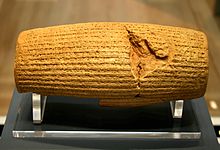
Cyrus
Cylinder
One of the few surviving sources of
information that can be dated directly to Cyrus's time is the Cyrus Cylinder, a
document in the form of a clay cylinder inscribed in Akkadian cuneiform. It had been placed in the foundations
of the Esagila (the temple of Marduk in Babylon) as a foundation
deposit
following the Persian conquest in 539 BC. It was discovered in 1879 and is kept
today in the British Museum in London.
The text of the cylinder denounces the
deposed Babylonian king Nabonidus as impious and portrays Cyrus as pleasing to the chief
god Marduk. It describes how Cyrus had improved the lives of the
citizens of Babylonia, repatriated displaced peoples and restored temples
and cult sanctuaries. Although not mentioned specifically in the text, the
repatriation of the Jews from their "Babylonian
captivity"
has been interpreted as part of this general policy.
The Bible
mentions Cyrus, the King of Persia, in several places. In the book of Isaiah, God calls Cyrus his anointed
and says that he will subdue nations and strip kings of their armor. In the book
of Ezra, it is mentioned that Cyrus commanded the Jews to build a temple to God
in Jerusalem. The book of
2nd Chronicles also mentions Cyrus as the king who appointed the
Jews to rebuild the temple in Jerusalem .Cyrus is
considered a significant figure in the Bible because he allowed the Jews to
return to their homeland and rebuild the temple in Jerusalem. He is also
known for his role in ending the Babylonian captivity. Cyrus the
Great was a pagan king who was not a follower of the God of the Bible. However, he
is considered a significant figure in the Bible because he allowed the Jews to
return to their homeland and rebuild the temple in Jerusalem
It is worth noting that the book of Isiaih
was written somewhere between 740 BC and 686 BC, at least 106, and
perhaps as many as 150 years before Cyrus was born, yet in the passage of
Isaiah 44:24 – 45:7, as seen below, God
specifically names Cyrus and what he will do for God’s
people during his reign.
Isaiah 44:24Thus
says the LORD,
your Redeemer,
and He Who
formed you from the womb: I am
the LORD Who
makes all things; Who
alone stretches forth the heavens; Who
spreads abroad the earth by Myself;
25Who
frustrates the tokens of the liars, and makes diviners mad; Who
turns wise men backward, and makes their knowledge foolish; 26Who
confirms the word of His
servant, and performs the counsel of His
messengers; Who
says to Jerusalem, “You shall be inhabited”; and to the cities of Judah, “You
shall be built, and I
will raise up the decayed places thereof; 27Who
says to the deep, “Be dry, and I
will dry up thy rivers”; 28Who
says of Cyrus, “He is My
shepherd, and shall perform all My
pleasure; even saying to Jerusalem, ‘You shall be built’; and to the temple,
‘Your foundation shall be laid’”. Isaiah 45:1Thus
says the LORD
to His
anointed, to Cyrus, whose right hand I
have held, to subdue nations before him; and I
will loosen the loins of kings, to open before him the two-leaved gates; and
the gates shall not be shut: 2I
will go before you, and make the crooked places straight; I
will break in pieces the gates of bronze, and cut in sunder the bars of
iron; 3And I
will give you the treasures of darkness, and hidden riches of secret places,
that you may know that I,
the LORD,
Who
call you by your name, am the God
of Israel. 4For Jacob, My
servant's sake, and Israel My
elect, I
have even called you by your name; I
have surnamed you, though you have not known Me.
5I am
the LORD,
and there is none else, there is no God
beside Me;
I
girded you, though you have not known Me,
6That they, from the rising of
the sun, and from the west, may know that there is none beside Me.
I am
the LORD,
and there is none else. 7I
form the light, and create darkness; I
make peace, and create calamity; I,
the LORD,
do all these things.
Darius the Mede (Daniel 6:1)
After Belshazzar is killed, Darius the Mede
takes the kingdom of Babylon, but only for two years. Little is known of him.
Seven theories as to his identity by scholars are summarized here.
The
biblical book of Daniel describes a king called “Darius the Mede,” the son of
Ahasuerus, who assumed rule over the Neo-Babylonian Empire after the fall of
Babylon to a Medo-Persian force (Daniel 5:31).
Darius the Mede is a major character in Daniel
6, and the vision of Daniel 9 is
said to have occurred during his reign. However, a problem arises when trying
to identify Darius the Mede in ancient non-biblical literature. Based on the
non-biblical sources, the conventional view of modern historians is that Cyrus the Persian conquered Media ca. 553 BC and deposed
the last Median king. According to this version of history, Cyrus, as king of
Persia, reigned as supreme ruler of the entire Mede-Persian Empire when Babylon
fell in 539 BC.
This is the first of three references to rulers named Darius
in the Bible. It is found in the book
of Daniel, where this Darius is called Darius the Mede (Daniel
6:1-26). This Darius only ruled for two years (538–536 BC) and is best
known as the ruler who promoted Daniel to a high position in the kingdom and
then cast him into the lions’ den, much against his own wishes. When he saw
that Daniel was unharmed by the lions, this Darius decreed that “people must
fear and reverence the God of Daniel. For He is the living God and He endures forever; His kingdom will not be
destroyed, His dominion will never end.” Scholars have tried to solve the problem
by identifying Darius the Mede from extrabiblical sources that offer seven
different explanations - as: (1) fiction;
(2) as Gubaru, named
governor of Babylonia by Cyrus; (3) as Cyrus; (4) as
historical, but of uncertain identity; (5) as Cambyses II; (6) as Astyages; and
(7) as Cyaxares II. The
gist of explanation #1 is to dismiss the book of Daniel as an historical source with theological
motives – seeking to prove that the book of Daniel is not the Word of God - but a work of fiction. There are five cogent objections to explanation #1; as well as to
explanation #2 and explanation #3; the others have fewer objections. It is possible that Daniel used the word Darius (which means
“lord”) as a title for the ruler in Babylon, rather than his proper
personal name.
Daniel
6:28 refers to “the reign of Darius and the reign of Cyrus the Persian,”
showing that Darius and Cyrus ruled concurrently. This has caused Bible
scholars to posit that Darius was appointed viceroy over Babylon by his nephew,
King Cyrus.
521–486 BC
The book of Ezra mentions another king named Darius, also known
as Darius I or Darius the Great. This was the son of Hystaspes, a king of
Parsa. This Darius ruled Persia from about 521 to 486 BC. Darius I is presented
in Ezra as a good king who helped the Israelites in several ways. Prior to the
reign of this Darius, the Jews who had returned from the Babylonian Captivity had begun rebuilding the temple in Jerusalem. At
that time, Israel’s enemies did everything in their power to disrupt the
construction, and they had succeeded in halting the building during the reigns of
the kings Ahasuerus and Artaxerxes (Ezra 4:1–24).
There
is some debate about the identity of the “Ahasuerus” or “Xerxes” mentioned in
Ezra 4:6 as ruling before Darius I. It is likely that this king is also known
in history as Cambyses II, a son of Cyrus the Great. The “Artaxerxes” in verse
7 is called, in other historical records, “Smerdis”
or “Bardiya”, another son of Cyrus (or possibly an impostor taking his place).
That king ruled only seven or eight months. A related theory suggests that Ezra
spoke of Cambyses using his Chaldee name (Ahasuems)
in verse 6, and by his Persian name or title (Artaxerxes) in verse 7. In
that case, Ahasuerus and Artaxerxes refer to the same person—the
king who immediately preceded Darius.
When
this Darius became king, construction of the temple resumed in the second year
of his reign. But the Jews’ enemies again attempted to thwart their efforts.
Tattenai, the Persian governor of Judea, wrote a letter to Darius to try to
turn the king against the Israelites and stop the building of the temple. But
Darius responded by commanding Tattenai and his companions to stay far away
from the site and let the Jewish elders continue with the rebuilding.
Furthermore, the king decreed that the Jewish workers were to be paid from the
royal treasury, that the builders would be given whatever was needed for the
burnt offerings, and that anyone attempting to destroy the temple or disobey
his decree would be impaled on a beam from his own house, which would then be
made a pile of rubble (Ezra 6:1–12).
By his decrees, Darius I showed himself to be a friend of Israel, and the Jews
in Jerusalem prospered under his watch. The temple was completed in the sixth year of his reign (Ezra 6:15).
336–331
Darius the Persian
A
third reference to a ruler named Darius occurs in Nehemiah 12:22, which refers
to the “reign of Darius the Persian.” It is also unclear exactly who this
Darius is, but most historians believe it to be Darius Codomannus, the last
king of the Persian monarchy who was defeated by Alexander the Great.
356–323
Alexander "The Great" (336 - 323 BC)
Alexander, the son of
Philip of Macedon, was born in the year 356 BC. When he was just 20 years old, in
336 BC, his father was assassinated and he ascended to the throne of Macedonia.
He immediately began to implement his father's plans for world conquest. He
quickly conquered the surrounding nations and then turned toward the Persian
Empire.
In battle, Alexander seemed unstoppable. In just four years he had
conquered the entire Persian Empire, which included Syria, Palestine, the Greek
states, and all of Egypt. The Egyptians were so glad to be free of Persian
domination that they declared Alexander to be the son of their god Ammon,
dedicated a temple to him, and named the city of Alexandria, in northern Egypt,
in honor of him.
He next turned his attention to Russia & India, conquering
much of both countries. Alexander was also a very sympathetic, understanding,
and kind administrator of his conquests. He was a benevolent ruler, and most of
the conquered peoples regarded him very highly. He not only won their
territory; he also won their favor.
As a gesture of reconciliation with Bactria (a part of Russian
Turkestan), Alexander married Roxana, a Bactrian princess. His only child, a
son, was born to Roxana shortly after his death. Alexander planned a sea voyage
to Arabia in 323 BC, but he died of a fever in June of that year, at the age of
33, before that campaign could begin.
While his strength lay in military strategy and leadership, his
greatest historic impact and legacy was in extending the Greek culture to all
the lands he conquered. Despite being a Macedonian by birth, he loved and
promoted the Greek culture with the zeal of a missionary everywhere he went. He
received a classic education, studying under Aristotle, and he carried copies
of the Iliad and the Odyssey on all his campaigns; and is reputed
to have had a copy of the Iliad and a dagger under his pillow.
With each conquest, he ordered his troops to marry the local women
to expand the Greek population. He also ordered the Greek language to be taught
to all conquered people, and that Greek was to be the official language of the
empire. Alexander was very effective in propagating the Greek culture. He died
in his palace in Babylon in 323 BC. The cause of death was said to be a fever
after a night of heavy drinking, but there were rumors that he may have been
poisoned, or may have even taken his own life.
After
Alexander’s Death – Struggle for a Successor
When Alexander died in 323
BC, he left no heir to the throne, triggering a period of intense competition
between his senior generals to gain control of the vast empire. This was
further complicated when his wife, Roxana, gave birth to a son, who should then
be his heir to the throne. That prospect was terminated when Cassander, one of
his generals, killed both Alexander’s widow, Roxana, and her baby boy.
This contention between the
generals persisted until 315 BC, when it was agreed to divide the kingdom among
his top four generals. This four-way split of the empire was predicted long
beforehand in Daniel 8:21-22. These
four generals were known as the Diadochoi,
which in Greek means "Successors." They were:
1.
Ptolemy Lagi - who ruled over Egypt, Palestine, Arabia, and Peterea. He was assisted by a general named Seleucus, who
had originally been given Babylon, but who was later forced out by Antigonus.
2.
Antigonus - who controlled Syria, Babylonia, and central Asia.
3.
Cassander - who ruled over Macedonia and Greece.
4.
Lysimachus - who was the ruler of Thrace and Bythinia.
Despite having divided the kingdom between them, these Diadochoi continued to fight with each another.
Violent aggression was a frequent occurrence as they contended for each other's
territory. Antigonus was probably the most hated of the generals of the late
Alexander the Great. The others finally colluded and drove him out in 312 BC.
His family members fled to Macedonia where they set up a small kingdom, but it
had little impact on to world history.
General Seleucus then seized to opportunity to take back the
territory that was originally given to him. This area - Syria and Babylonia -
then became the Seleucid Dynasty. About the same time, Ptolemy Lagi
expanded his territory north from Egypt to include Israel, the area occupied by
the Jews. The Jews then remained under the rule of the Ptolemies until 198 BC.
After the Battle of Ipsus (301 BC), Seleucus managed to
take all the territory previously held by Antigonus; including the kingdom of
Lysimachus (Thrace) that was absorbed into the Seleucid Dynasty. So, exception
for that small Macedonian kingdom, the entire empire was now controlled by and
was divided between the Seleucids in the North and the Ptolemies in the South.
Palestine was caught between these two struggling factions, and it became the
battleground between the Seleucids and the Ptolemies. The Ptolemies prevailed
over the Seleucids in their struggle over Palestine (Israel) for about the
first 100 years. Following is a summation of rule by these
two faction over that region from 323 to 163 BC.
The Ptolemies Control
Palestine (323 - 198 BC)
As stated above, the Ptolemies, who ruled from the land of Egypt,
were the first to maintain any real consistent control of Palestine after the
death of Alexander. They were generally benign rulers over their Jewish
subjects, despite taxing them quite heavily.
Ptolemy I, Soter
(323 - 285 BC)
This ruler, aka Ptolemy Lagi, and was one of the Diadochoi. Palestine came under the dominion of the
Ptolemies during his reign. He also relocated many of the Palestinian Jews to
the land of Egypt where Greek soon became their native language.
Ptolemy II, Philadelphus (285 - 246 BC)
The son of Ptolemy I, he ruled the Jews, both in Egypt and
Palestine, who enjoyed a lengthy period of peace, quiet, and modest prosperity.
These earlier Ptolemies concerned themselves with intellectual pursuits more
than with military pursuits. In Palestine, the High Priest, was allowed to rule
as a political under-lord of the Ptolemies, aided by a council of priests and
elders, and were left pretty much unmolested as long as they paid their annual
tribute of 20 talents.
In Egypt, the Jews were allowed to build Synagogues to
worship and study in, and Alexandria soon became an influential Jewish center.
Under the rule of Ptolemy II, the Jewish Scriptures were translated into the
Greek language. This translation is known as the Septuagint (LXX), a
translation which would become the most popular version of the Scriptures among
the Jews of the dispersion, and which would be used a great deal by the writers
of the New Testament books.
Two of the Seleucid rulers
of the Syrian Empire -
- Antiochus
I (280 - 262 BC) --- In the year 280 BC General Seleucus was murdered, and
his son, Antiochus I, took the throne of the Seleucid Dynasty. Five years
later his empire was invaded by Ptolemy II (aka Philadelphus). This war
lasted almost four years, with neither side winning a decisive victory
over the other.
- Antiochus
II (261 - 247 BC) --- In 261 BC this man succeeded his father to the throne,
and immediately war broke out again between the two parts of the former
empire. In 252 BC a peace agreement was finally reached when neither side
was able to defeat the other. To complicate matters even further, as part
of the peace agreement Ptolemy II's daughter, Berenice, was given in
marriage to Antiochus II, with the goal of uniting the two parts (the
Seleucids and Ptolemies).
Ptolemy III, Euergetes I (246
- 221 BC)
At about the same time, both Ptolemy II (aka Philadelphus) and Antiochus
II died. Ptolemy II was succeeded by Ptolemy III, (aka Euergetes
I,) and Antiochus II was succeeded by his son SELEUCUS II (247 - 226 BC). Once
again war broke out between the two parts of the empire. The cause this time
was: Laodice (the half-sister, and also the wife, of Antiochus II) wanted her
son to one day occupy the Seleucid throne, rather than the son of Berenice. And
so, Laodice killed Berenice and her infant son.
This outraged the Ptolemies of the southern kingdom, sparking the
famous Laodicean War. The Ptolemies did well in this war and even
managed to capture a large part of the Seleucid Empire, including all of Syria,
before local problems called Ptolemy III back to Egypt. When Ptolemy III was no
longer on the battlefield, Seleucus II managed to recapture much of his
territory. He also tried to capture Palestine, but was unable to do so. Peace
finally was declared in 240 BC.
Seleucus II was succeeded in 226 BC by Seleucus III (226 - 223 BC)
who reigned only 3 years before being poisoned. He was then succeeded by his
younger brother, known as Antiochus III, The Great (223 - 187 BC).
Ptolemy IV, (aka Philopater) - (221 - 203 BC)
In the year 221 BC, Ptolemy III died and was succeeded by Ptolemy
IV, (aka Philopater), who was the most cruel and vicious ruler of the
Ptolemies. He hated the Jews, and persecuted them without mercy. He even tried
to force his way into the Holy of Holies in the Jewish Temple to defile it. The
Jews detested this madman, and when he died in 203 BC, it was celebrated with
great rejoicing.
Ptolemy V,
Epiphanes (203 - 180 BC)
Ptolemy V, (ala Epiphanes "the illustrious one"),
was the last of the Ptolemaic line to rule over Palestine and the people of
Israel; but he was not the last of the Ptolemaic rulers. (The Ptolemaic Dynasty
did not come to an end until 30 BC when the famous Cleopatra died.)
In 198 BC the Seleucids, under Antiochus III, finally got control
of Palestine, which they held, more or less (mostly less), until the
coming of the Romans in 63 BC.
Antiochus III, The Great (223 - 187 BC)
This ruler was only 18 years old when he ascended the throne of
the Seleucid Empire in 223 BC. Even though young, he was nevertheless
experienced in government as he had served as Governor of the province of
Babylonia under his brother Seleucus III. Antiochus immediately began an effort
to conquer the troublesome empire of the Ptolemies. Although he was unable to
completely destroy them, yet at the Battle of Panion
in the Jordan Valley (198 BC) he was able to gain complete control of
Palestine.
The Jews were at first happy by this state of affairs. The
constant warring between the two dynasties seemed finally to be at an end, and
they welcomed Antiochus with open arms. Little did they realize, however, that
the Seleucids would prove to be even harsher masters than the Ptolemies.
At about this same time, Hannibal, who had been defeated by the
Romans at Zama, fled to the court of Antiochus for protection. Still interested
in stirring up trouble for Rome, however, he convinced Antiochus to invade
Greece, whereupon Rome promptly declared war on Antiochus. The Romans defeated
Antiochus in 190 BC, and made him pay dearly for his alliance with Hannibal. He
was forced to pay enormous amounts of money, and to surrender his navy and his
war elephants. To insure that Antiochus continued making his payments, the
Romans took his youngest son to Rome where they kept him hostage for twelve
years. This young boy would later return to the Seleucid Empire and assume the
throne under the name Antiochus Epiphanes.
The Seleucids Control Palestine (198 - 168 BC)
We've already examined the
rulers of the Seleucid Dynasty who were contemporaries of the Ptolemies during
the latter's control of Palestine. Following are the Seleucid rulers who held
control over Palestine and Israel after they took control from the Ptolemies.
Seleucus IV (187
- 175 BC)
Three years after his defeat by the Romans, Antiochus the Great
died and was succeeded by Seleucus IV, who ruled
for the next twelve years. His situation was a most precarious one – for some
reason, he had to come up with fantastic amounts of money to send to the
Romans. He heavily taxed the people of the land, including the Jews of
Palestine, to raise this money. This created a moral dilemma for the Jews. Some
felt it was morally acceptable to pay money to the government, whereas others
felt it was sinful. Thus, two opposing factions formed among the Jews over this
issue. The Oniads, under the leadership of the
High Priest Onias, were opposed to helping the
Seleucids in any way. The other group, led by a man named Jason, felt the
opposite, and set about making many false, slanderous reports to the king
concerning Onias, in the hopes of undermining him.
Jason, who was the brother of Onias, was
only interested in one thing -- becoming the High Priest in his brother's
place. He hoped to accomplish this by offering the Seleucids large amounts of
money (see -- II Maccabees 3-4 and Josephus: Antiquities of the Jews,
Book 12, Chapters 4-5). King Seleucus IV ignored the Jewish squabble, for the
most part, and refused to get that deeply involved.
Antiochus IV, Epiphanes (175 -
163 BC)
In the year 175 BC, Antiochus IV (aka
Epiphanes),
murdered Seleucus IV and took the throne. He immediately took advantage of
Jason's offer of money, and removed Onias from the
office of High Priest, installing Jason in his place. Three years later, a man
named Menelaus offered Antiochus even more money, so he removed Jason and made
Menelaus the High Priest.
Those Jews who were still trying to be faithful to their God, were infuriated by this
sordid affair, and were pained that the position of High Priest could be bought
by the highest bidder. Those who were outspoken about these abuses were known
as the Hasidim ("the pious ones"). It is from this group that
the Hasidic Jews of today trace their roots. They renamed Antiochus --
"Epimanes" ("the madman").
In the year 169 BC Antiochus invaded Egypt in a final attempt to
destroy the Ptolemaic Dynasty. It was soon (falsely) reported back in Palestine
that the king had been killed in battle. When this news reached Jason, he
returned from exile and threw Menelaus out of the city and again assumed the
office of High Priest. The news of his death proved false, however, and when he
returned to Jerusalem he used his army to forcibly remove Jason from office and
reinstatel Menelaus. At this time Antiochus also
entered the Temple and stole a great deal of valuable treasure, an act which
the pious Jews looked upon as an abomination before God.
The following year (168 BC) Antiochus renewed his campaign
against the Egyptians, but he was stopped by the Roman representative Popilius Laenus, and was ordered to leave Egypt and never
come back. This so infuriated Antiochus that he came back and took out his
frustration on the city of Jerusalem. He tore down the city walls, slaughtered
a great many of the Jews, ordered the Jewish Scriptures to be destroyed, and he
and his soldiers brought prostitutes into the Temple and had sex with them
there in order to defile the Temple. He also issued orders that everyone was to
worship the Greek gods, and he established the death penalty for anyone who
practiced circumcision, or who observed the Sabbath or any of the Jewish
religious feasts and sacrifices.
The cruelty of Antiochus in enforcing these new laws against the
Jews became legendary. An aged scribe by the name of Eleazar was flogged to
death because he refused to eat the flesh of a swine. In another incident, a
mother and her seven young children were each butchered, in the presence of the
Governor, for refusing to worship an idol. In yet another incident, two
mothers, who had circumcised their newborn sons, were driven through the city
and then thrown to their deaths from the top of a large building.
The final outrage for the pious Jews of the land came when Antiochus
sacked the Temple and erected an altar there to the pagan god Zeus. Then, on
December 25, 168 BC, Antiochus offered a pig to Zeus on the altar of God. This was the last straw!
The Jews had taken all they were going to take from these oppressors. The stage
was set for a large-scale rebellion of the Jews against the Seleucids. This
famous rebellion is known in history as the Maccabean Revolt.
(End
of this synopsis of ancient world history)